In the past several winters, I have been doing more and more ice fishing. What started out as part of my work with the Freshwater Fisheries Society of BC to promote winter fishing opportunities, has turned into one of our family’s favourite pastimes. Last February, we gave Tunkwa Lake a go in February. While others caught some fish, I was unsuccessful so I was quite determined to return and redeem myself.
Contrary to what most people think, ice fishing is in fact quite challenging and physically demanding. You are limited by what little daylight you have in the winter. It is often a guessing game when trying to find out where the fish might be at the very beginning. You drill a hole, look for the right depth and bottom structure, then you wait. If there are no fish, you pack everything up, move, drill more holes and wait some more. When the fish do show up, they often can be picky. Three scenarios could happen, they will either completely ignore your bait and swim off, peck at it a few times and move on, or grab the entire offering right away. This fishery is unpredictable, which makes having consistent results difficult if you have not done it often.
With that said, a challenge is always fun! According to our good friend Al Patton at Tunkwa Lake Resort, the fishing is typically best at the very beginning of the ice fishing season. This time, rather than venturing to the lake in February, we decided to make a trip there in December.
Last weekend, I popped into Cabela’s in Abbotsford, where it is well stocked with ice fishing gear so I could be prepared this time. With a proper ice fishing shelter, lighter rods, an auger that drills bigger holes, I was quite confident that we would catch more fish this time!
The weather was on our side as we drove up to the lake last Sunday. Sunny, yet not too cold, conditions were perfect for both anglers and fish. We arrived late in the day so settled in the warm cabin so we could be up early for the morning bite.
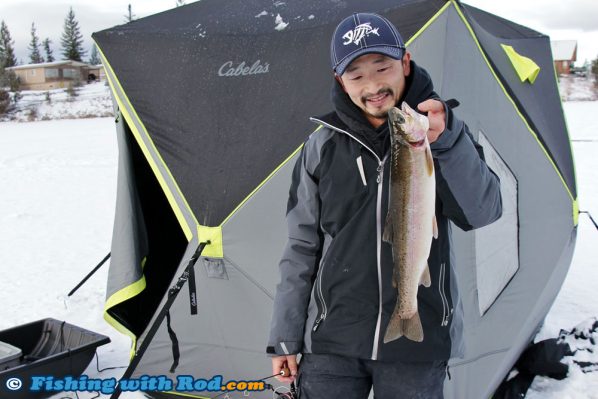
The first morning, we headed to the bay where Al had been doing well lately. Our first order of business was to get the ice fishing shelter up once the holes were drilled. The shelter serves several purposes. It keeps us warm, creates a dark environment so we could see the fish through the holes, and lastly it keeps the kids comfortable. As soon as we set everything up for fishing, I spotted a few nice rainbow trout cruising by below us! These fish looked to be around 16 to 18 inches long. They swam in and out of our field of view, but were not interested in our bait.
By mid afternoon, the mood of these fish suddenly changed. Instead of simply swimming by, they were finally stopping and chomping down the worms on our jigs. The first fish coming out of the hole was a fat 16 inch Pennask rainbow trout. This was followed by several more fish which all aggressively grabbed our offerings until it became too dark to see by 4:30pm.
The next day was a slow one, the bite was simply not on for whatever reason. Fish could be seen swimming by occasionally, but the numbers were not there. Instead, we spent the day wandering on the ice, shuttling between the ice shelter and the cabin, mixing a bit of sledding. One great thing about ice fishing is all the other fun activities which come with it, so the kids rarely get bored.
On our final day, my oldest son and I decided to return to the ice shelter at 9:00am to see if there’d be some early morning biters. As soon as we had everything set up, both of us could see fish circling around us. Big and small, they appeared to be hungry. One particular fish, was swimming just below the ice, feeding on scuds. I first dropped the worm down, but it was not interested at all. After several attempts, it was time for a switch. Next up, a few single eggs were threaded onto the hook. It took a glance, but once again the bait was ignored. After about 30 minutes, I had one more option in my box. I took out a jar of Pautzke Bait’s Fire Bait, which worked really well on brook trout while I was fishing at Edith Lake last season. I rolled a ball of the chartreuse dough bait onto the hook, shaped it into a worm. I dropped it down to just one foot below the ice where the fish had been suspending. Both of us had our eyes on the bait as the fish approached, and to our surprise, it sucked in the entire jig with no hesitation! This 18 inch fish went for a robust run as I handed the rod to junior, who was screaming in excitement while cranking the reel handle. Eventually both of us brought the fish out of the hole, which was the highlight of the entire trip.
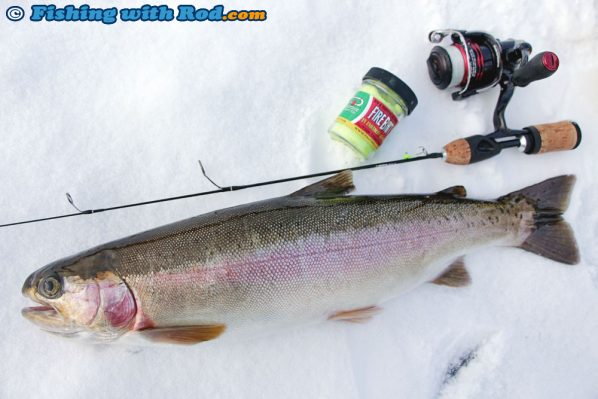
Overall, our second ice fishing trip to Tunkwa Lake was a successful one. While only about half a dozen fish were caught, it was a really fun experience for everyone in the family! It’s important to note that the fishing is best early in the morning and late in the afternoon when lighting is still low, so invest your fishing effort during those two periods, and spend the rest of your day on other fun activities.
Now, unlike soft water fisheries, there are particular items you must have when going on an ice fishing trip, and here is a list which I’ve come up with so there’d be no surprises while out on the ice.
1. Proper clothings and footwear
The very first time I went ice fishing, I wore gum boots. My feet didn’t last very long even with two pairs of wool socks on. A pair of good winter boots can keep your feet out on the ice all day long. Our preference has been Sorel. They are comfortable, and keep the feet dry and warm regardless how snowy and cold it is. Proper waterproof outerwear are also needed. There’ll be times when you need to kneel or lay down on the ice. The key word here is dry. If you can stay dry, then you will can keep fishing throughout the day.
2. Augers and ice scoops
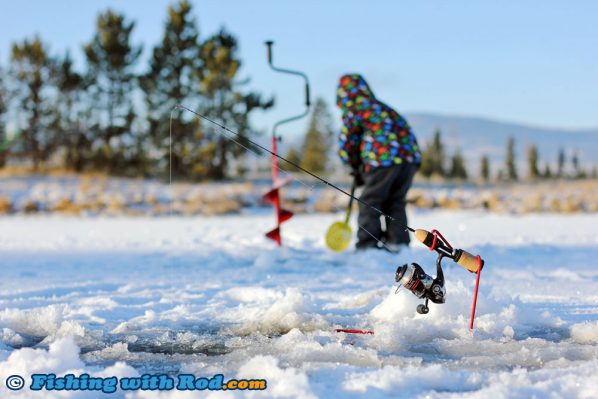
It is good to bring two augers with you just in case one breaks. This important tool is what gives you access to the water through the ice, so without a functional one your fishing day is over. There are generally two different sizes available – 6” and 8”. We use the 8” auger from Eskimo because the bigger hole allows you to see more, and makes landing fish a lot easier. An ice scoop is needed to remove the excess slush in your hole. The last thing you want to be doing is to use your hands for this. I have been using a Frabill ice scoop. It’s long, so I don’t have to bend down to scoop, which makes a huge difference on your back when the weather is cold. The large scoop also gets the job done a lot faster.
3. Ice fishing rods
Don’t use a conventional spinning rod. An ice fishing rod is much shorter because it is difficult to aim with a longer rod when your fishing space is only 8 inches wide. I have been using these Frabill Bro series ice fishing rods, which are fantastic for both rainbow and brook trout as the tip is incredibly sensitive yet the blank is still fast enough to handle bigger fish. Coupling with the rods are my trusty Shimano Stradic 1000CI4+, which are light, smooth and durable. I spool my reels with Seaguar STS 6lb test fluorocarbon line, which is stiff and does not stretch, making it ideal for ice fishing.
4. Ice fishing shelter
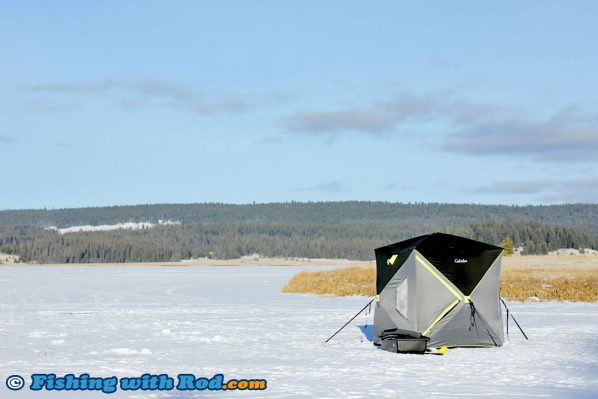
As mentioned earlier, an ice fishing shelter makes your ice fishing experience a lot more comfortable. The tent keeps you away from the elements when the weather is bad. A heater in the tent also means no frozen fingers and icy lines. When sitting in the tent, it is completely dark above the ice while the water body remains bright from the surrounding light. This allows you to see every single fish in the water. We have been using Cabela’s Two-Person Hub ice shelter. This tent only weighs 30lb so can easily be set up and packed up by one person. Once popped up, the inside space is 36 square feet, enough to fit up to 3 people comfortably.
5. Bait, lures and flies
Be sure to carry a variety of offerings in your box when ice fishing. In spring time, trout usually key in on particular aquatic insects and catching them is a lot easier once you “match the hatch”. When ice fishing, fish can in fact be incredibly picky. What works one day is often ignored on the next, so it’s important to constantly switch up and work them differently by either keeping it stationary or jigging it lightly. The must-haves in my box include Pautzke Bait’s Fire Bait and pink shrimp eggs, 1/8oz or 1/16oz Gibbs Croc spoons (for jigging alone), Ironhead spoons (used as a flasher), deli shrimp, and of course dew worm.
6. Food and drink
When sitting in your ice fishing shelter, you’ll find that there can be a lot of down time if the fishing is slow. Food and warm drinks in a thermos can really make your outing much more enjoyable.
7. Sled
Finally, make sure you have a sled to carry all the above items! The last thing you want to do is to carry everything by hand from your vehicle to where you want to fish. There are different sizes of sleds to choose from, so make sure you choose one that can fit your ice shelter and everything else in.
Ice fishing is a very social activity. Spend a bit of time planning out what to bring can improve the experience for both you and your partners. The theme in the list above is time saving. Because your total fishing time during the day is perhaps six hours long, it’s rather important to be efficient, and the above tools can help you to achieve that. Between December and early March, many lakes in Interior British Columbia offer these fantastic opportunities so be sure to take advantage of them if you have a freshwater fishing licence.
Videos: