
Bull Trout
Salvelinus confluentus
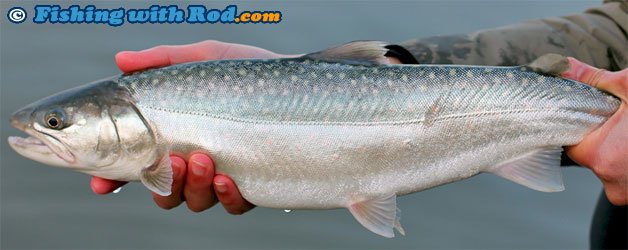
Although not as well known as salmon and trout, bull trout can actually be found in many rivers and lakes across British Columbia. In recent years, conservation effort has resulted in the great comeback of this magnificent species. Once regarded as pests due to their predatory threats on salmon populations, bull trout are now popular gamefish among anglers. They are characterized by beautiful spots along the entire body. If you fish the Fraser River frequently during spring and fall or salmon bearing streams during winter, most likely you have encountered a few bull trout. In coastal watersheds, bull trout are both competitors and predators of pacific salmon. It is a mysterious species that is often confused with the dolly varden, a species that closely resembles a bull trout morphologically yet they are distant relatives.
Description
Bull trout belong in the Salmonidae family, their relatives include salmon, trout and whitefish. More specifically, it is one of many char species found in the Northern Hemisphere. Chars possess a body shape similar to salmon or trout, however they have oval white spots on their body. Besides these distinctive white spots, bull trout also have small reddish/pink spots along their lateral line. When they are in the ocean, they are very silver in colour and both types of spots are difficult to see unless examined closely. On the other hand, during the freshwater phase or spawning period, these fish will become darker. As mentioned in the introduction, the bull trout is often misidentified as a dolly varden due to their similarities.
Distribution
Distribution of bull trout varies greatly. They are found in parts of Alaska and Yukon, the Pacific Northwest and Northern California. Depending on the time of the year, they can either be found in the sea, estuary system, mountain streams as well as inland lakes. In British Columbia, they exist in almost all of the streams and large lakes. In Southern British Columbia, they are found in the Squamish River, Fraser River and its tributaries depending on the time of the year. Certain time of the year they can also be found in Burrard Inlet, Howe Sound and Indian Arm.
Life History
Their life span is quite long, a large 10 pound fish can be up to 8 years old. They grow much more slowly compared to their salmonid cousins. Sexual maturation does not occur until the age of 3 or 4. Spawning periods for bull trout take place during fall and early winter in mountainous streams. They are direct competitors of returning salmon. Unlike salmon, these fish do not die after spawning. Once spring rolls around, adults hunt down newly-hatched salmon fry for food. Coastal bull trout are described as amphidromous, meaning they will move between salt and freshwater without a regular pattern. Food is the major factor that determines where they will be at a particular time. As summer approaches, they move towards the estuary system with salmon fry/smolts (food) and during the summer months they live in the coastal water where food is plentiful. They are opportunists, which eat whatever is available in the habitat.
Fishing Locations
Except Vancouver Island, bull trout can be found in just about every stream and lake in British Columbia. In Southern BC, there are many fishing locations where you can catch bull trout. Usually, at any barfishing locations along the Fraser River you will encounter them when fishing for salmon. During late fall and early spring, try fishing the Tidal Fraser and Pitt Rivers.
In the winter months, you can also try streams where bull trout feed on salmon eggs. Streams such as the Squamish River, Cheakamus River, Upper Pitt River, Coquitlam River, Chilliwack River and Harrison River provide good fishing for bull trout. These fish are found in the estuaries during spring when salmon fry start their migration into the Pacific Ocean.
Lakes and streams in the Kootenay and Okanagan regions also provide good bull trout fishing. These predatory fish tend to be larger as they feed on small resident rainbow and cutthroat trout in these two regions.
Fishing Techniques
When fishing for bull trout in the Tidal Fraser River, you can either use bait (if a bait ban is not in effect) or lures. Small spoons and spinners that immitate juvenile salmon and other baitfish work great between April and June, while a hook baited with roe is effective between September and December when salmon return to spawn.
When fishing for bull trout in streams, float fishing with egg patterns can work great during the salmon season. Spoons and spinners never fail because the vibration is difficult to resist for a bull trout. Once salmon spawning takes place, flyfishing with either egg or flesh patterns usually work well. Once juvenile salmon begin to emerge, minnow patterns should be used due to a shift in bull trout's diet.
Bull trout are not targeted specifically in the ocean due to their low abundance. Occasionally feeding fish can be caught near estuaries, kelp beds and other structures.