
Largescale Sucker
Catostomus macrocheilus
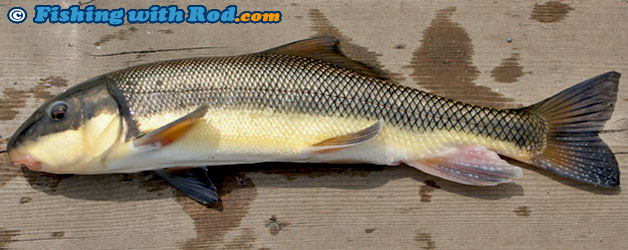
Its face can be shocking when it first emerges from the water. The largescale sucker is a freshwater species that can often be caught while targeting salmon and trout.
Description
The most distinct feature of a largescale sucker is its mouth, which is located on the bottom of its head rather than the front. Like its cousins in the minnow family, it does not have an adipose fin. Its scales are carp-like, they are fairly large. The top side of the fish is often greenish-grey in colour, while its belly is usually white or creamy. A largescale sucker can reach just over half a meter long.
Distribution
Largescale suckers can be found across Western Canada, and parts of US, including Idaho, Washington and Oregon.
Life History
They are mainly found in large rivers and some lakes. Youngs feed on aquatic invertebrates, while adults are mainly bottom feeders. Adults will feed on algae, mollusks as well as salmon eggs when available.
Fishing Locations
Any large salmon bearing streams and sloughs will produce largescale suckers. During the summer months, they will venture down the large systems into the estuaries. Look for sloughs, pools and shallow runs where water tends to be slow.
Fishing Techniques
Largescale suckers are usually by-catches when salmon fishing in rivers. They can be enticed easily by a baited hook. Bait such as dew worms, dough, salmon roe, shrimp will usually produce. A small plastic worm jig can be effective at times as well. Look for shallow, slow portions of a large river when fishing for largescale suckers. Although edible, they are very bony.