
Coho Salmon
Oncorhynchus kisutch
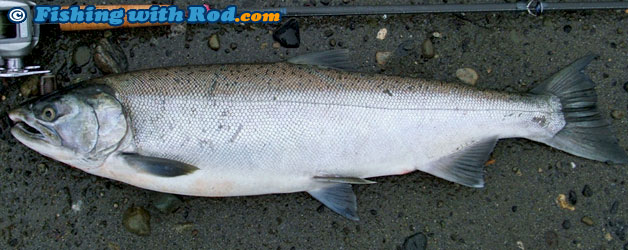
It is one of the top gamefish species in the Pacific Northwest. Coho salmon are targeted by anglers both in the ocean and rivers due to their acrobatic skills, powerful runs and tasty meat. Characterized by their ability to retain their chrome appearance until just before the final spawning stage, coho salmon are also commonly known as "silvers" or "bluebacks".
Description
Coho salmon have many distinct features that separate them from other members of the pacific salmon species. Small rearing juveniles have parr marks that run across their entire body. They have white gums, black tongues and numerous small spots along their back. During the ocean phase, their body is silver in colour, with a blue metallic back. Their square tail has a wide base that is scattered with some spots, normally on the upper portion.
Adults' average weight ranges between 4lb to 15lb, but fish beyond this range are not rare, especially in Northern BC and Alaska. Small prematured spawning males between 25cm and 35cm in length are known as "jacks", which return to their natal streams one year earlier than other adults. During spawning, adult males develop a distinct "hooked nose". Body colouration during spawning is red.
Distribution
Coho salmon are found along the West Coast of North America, from Alaska to Oregon. They are also found in many regions along Northeastern Asia. During the adult ocean phase, these pelagic predators patrol around the North Pacific Ocean. Prior to entering their natal streams, they feed heavily near kelp beds and beaches, where baitfish and crustaceans are found. In the final spawning stage, they prefer to occupy waters that are generally slow and shallow such as sloughs, creeks and pools.
Life History
Like all pacific salmon species, coho salmon have an anadromous lifecycle. Average lifespan is between 3 to 4 years but some males may return as early as in two years. Emerging from the eggs stage around late winter, small fries will rear in streams and feed on insects for one year before migrating into the ocean. They spend up to two years in the ocean and growing rapidly during the final year. When matured, they move into their natal streams to complete the lifecycle by spawning. Once spawning is completed, adults die from exhaustion and their carcasses become the base of the nutrient cycle in the stream ecosystem.
Fishing Locations
Coho salmon are both targeted in the ocean and rivers. In the ocean, they are generally found along the kelp beds where they constantly feed on small baitfish species such as the needlefish and herring. They are also fished at river mouths where they stage prior to entering their natal streams. In freshwater, coho salmon are targeted in sloughs and streams where they hold before entering their spawning stage.
Fishing Techniques
There are many techniques that can be used to target coho salmon. These include trolling, mooching, bucktailing in the ocean, barfishing in large river systems, spincasting and flyfishing in estuaries and sloughs, float fishing in rivers. All of these techniques have their own advantages and excitement.
Common freshwater lures used for coho salmon include spoons, spinners that are silver or copper in colour. Bait used for drifting include freshly cured roe and dew worms. Artificial presentations such as wool, corkies, spin n' glow are also very effective at times.